Sunday, August 15, 2010

Stamp Investment Tip: Uzbekistan 1999 Horses Souvenir Sheet (Scott #181 )

In 1999, Uzbekistan issued a souvenir sheet picturing horses (Scott #181 ). Only 10,000 were issued, and Scott '10 values it at $ 3.50 for unused. While the sheet was almost certainly produced to generate revenue from sales to collectors, it is nevertheless an attractive, cheap, and scarce topical that is worth the ride. As Uzbekistan's economic prospects seem promising, the souvenir sheet is "twice lovable."

A nation of about 28 million, Uzbekistan relies mainly on the production or extraction of commodities, including cotton, gold, uranium, potassium, and natural gas. The government is slowly relaxing state control of the economy, although it remains hostile to allowing the development of a significant private sector. Average annual GDP growth has been outstanding, averaging 8% over the last 5 years. However, average income has remained low, at around $610 per year (2006), largely due to the fact that much of the country's prosperity has benefited a tiny ruling elite of corrupt bureaucrats. Reforms are obviously necessary, although given the country's abysmal human rights record, the road to change will probably be a bumpy one.


Many of the newly independent and newly resurrected nations of Europe and Central Asia have issued popular topical sets and souvenir sheets in modest quantities, and most are currently very inexpensive. I view such issues as low-risk speculations, as only time will tell whether either the development of stamp markets within these countries or topical appeal will push them significantly higher. In a sense, they're comparable to penny stocks, but not as risky.


Thursday, August 12, 2010

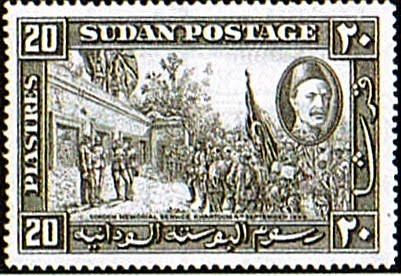
Stamp Investment Tip: Sudan 1935 Gordon Memorial Issue (Scott #51-59)

From 1899 through 1954, Sudan was officially under Anglo-Egyptian rule, but in fact administered as a British colony. In 1935, it issued a set of stamps commemorating the 50th anniversary of the matyrdom of General Charles George "Chinese" Gordon, one of the more colorful characters in the history of the British Empire (Scott #51-59). Gordon was killed in 1885 during the Mahdist Revolt , while unsuccessfully attempting to defend the besieged city of Khartoum. Ultimately, the British reasserted their control, reaching Omdurman, the Mahdist capital, in 1898. There, the British effectively used their shiny new Maxim machine guns to defeat a poorly armed native force more than twice the size of their own. Some 30,000 Mahdist soldiers were killed in the war, along with about 700 of the British forces, which included Egyptians and Sudanese.

The Gordon set strongly appeals to British Commonwealth collectors, as it beautifully illustrates the histrionic hubris and heroics of the former Empire. Only 5,500 were issued, and Scott '10 values it unused at $275.00 . I recommend the set based on my confidence in the growth of the British Commonwealth market, although it's possible that demand for it will receive an additional push should Sudan ever become a normal country.


Currently, Sudan is a nation of about 42 million people, living under what is perhaps the most vicious regime on the planet. It has suffered several civil wars over the last 50 years, including the current one being waged in Darfur, which has earned the government international condemnation and charges of genocide. The country is oil-rich, and currently exports over 180 million barrels per year. It also has significant deposits of natural gas, gold, silver, chrome, asbestos, manganese, gypsum, mica, zinc, iron, lead, uranium, copper, kaolin, cobalt, granite, nickel, tin, and aluminum. Agriculture production remains Sudan's most important sector, employing 80% of the workforce and contributing 39% of GDP, but most farms remain rain-fed and susceptible to drought. Political instability,adverse weather, and weak world agricultural prices ensures that much of the population will remain at or below the poverty line for years. Annual GDP growth has been very high, averaging almost 8% over the last five years. However, it is very likely that most (or all) of the prosperity has benefited only the ruling elite, as Sudan is not only one of the world's most murderous countries, but also one of the most corrupt.


That an attractive, historically significant set of stamps with such a meager printing quantity and some worldwide appeal, from a medium-sized country with valuable natural resources, is currently valued so low indicates a nearly total lack of a stamp market within that country, which is not surprising if the country is being run by mass murderers who do not care about the welfare of their fellow citizens. At worst, the Gordon set represents a conservative investment. If Sudan's situation improves, there will be ample reward for the patient investor who is willing to get in on the ground floor.


Tuesday, August 10, 2010

Stamp Investment Tip: Finland 1885 10m Brown and Rose (Scott #37)

In 1885, Finland issued a set of definitives picturing its coat of arms (Scott #31-37). Only 7,500 of the 10m high value (Scott #37) were issued, and Scott '10 values it at $ 625.00 for both unused and used. Many were probably used on parcels and then discarded. This is a truly scarce stamp, and its design is distinguishable from the more common 1890 10m Brown and Rose (Scott #45), in that #37 has the number "10" in all four corners.

I recommend consideration of all better stamps of Scandinavia. There are many collectors in Europe and the U.S. who focus on these countries as a group, and the scarcer classic items represent a solid conservative investment.


Finland, a nation of 5.3 million people, has a highly industrialized free-market economy focused largely on manufacturing. GDP growth has averaged about 3.6% annually over the last 5 years, although it declined recently due to the global financial crisis, and is now recovering. Finland's stamp collecting population is comparable to other Scandinavian countries, and will probably grow significantly as the nation ages over the next decades.

Those interested in joining a community of stamp investors, dealers, and collectors are welcome to join the "Stampselectors" group at Facebook. The group provides a useful venue for those who wish to buy, sell, and trade stamps, and discuss philatelic investing and practical aspects of stamp collecting.


Sunday, August 8, 2010

Stamp Investment Tip: South Korea 1957 Boy Scout Souvenir Sheet (Mi. Block #109)


In 1957, South Korea issued a set of stamps (Scott #245-46) and imperforate souvenir sheet (Michel Block #109) celebrating the 50th Anniversary of the Boy Scouts. While the set is relatively common (200,000 issued), only 1,000 of the souvenir sheets were issued, and Michel '06 values it at 4,200.- Euros for unused (Scott does not list the sheet). Michel does not issue a catalog for Asia every year, and its 2006 edition is its most recent. While the catalog value may seem high, it is sometimes possible to purchase the better, Michel-listed souvenir sheets of South Korea in VF NH condition for 30%-50% of catalog at auction.


I'm attracted to this scarce souvenir sheet both because it is an undervalued item from South Korea and because it is a Scouting Topical. I've tipped a number of better Scouting Topicals in the past, because the market for Scouting-related collectibles (including stamps) is similar to that of a mid-sized country. In 2007, Boy and Girl Scouts and Guides numbered 38 million members (of which 25 million were Boy Scouts) in 216 countries worldwide. Furthermore, the Boy Scouts actively promote the hobby among their members with a Stamp Collecting merit badge (pictured).


South Korea, a nation of about 50 million people, is one of the fastest growing economies in the world. Currently, it is the world's 13th largest economy and eighth largest exporter. It's export-fueled economic growth has led to a miraculous explosion in its GDP, from almost nothing 50 years ago to about $1 trillion today. Annual GDP growth has averaged 4.2% over the last 5 years, reflecting a slowdown in 2009 due to the global financial crisis. Furthermore, South Korea may be the most rapidly aging nation on earth, as its 65+ population is expected to more than quadruple from 9% in 2005 to 38% in 2050. Obviously, this could pose economic challenges for the country, but it will almost certainly add to its stamp collecting population.


Thursday, August 5, 2010

Stamp Investment Tip: Canada 1897 Diamond Jubilee Issue (Scott # 50-65)


On June 22, 1897, the British Empire celebrated Queen Victoria’s Diamond Jubilee, the 60th Anniversary of her accession to the throne. A holiday was declared in Britain and its colonies for the major event, and Canada issued a series of stamps featuring portraits of both a young and elderly Victoria (Scott #50-65). . The Diamond Jubilee stamps were the first commemorative stamps which Canada issued. There are sixteen different denominations, the highest of which was $5.00 - an astronomical amount for its day and one which few people could afford. As a result, the $1 - $5 values were printed in very low quantities.

I like the set as a whole, but especially favor the nine scarcest stamps within it, which have printings of 100,000 or fewer. I've listed them, along with their printing quantities and Scott '10 Catalog Values for unused, below:


- 6c Yellow Brown (Scott #55; 75,000; $ 230.-; $ 575.- for NH)
-15c Steel Blue (Scott #58; 100,000; $ 260.-; $ 650.- for NH)
-20c Vermilion (Scott #59: 100,000; $ 275.-; $ 625.- for NH)
-50c Ultramarine (Scott #60; 100,000; $ 375.-; $ 775.- for NH)
-$ 1 Lake (Scott #61; 24,900; $ 900.-; $ 2,400.- for NH)
-$ 2 Dark Purple (Scott #62; 25,000; $ 1,350.-; $ 3,600.- for NH)
-$ 3 Yellow Bister (Scott #63; 13,500; $1,400.-; $ 3,750.- for NH)
-$ 4 Purple (Scott #64; 14,500; $ 1,400.-; $ 3,750.- for NH)
-$ 5 Olive Green (Scott #65; 15,500; $ 1,450.-; $ 3,750.- for NH)


I am very optimistic about Canada's prospects for economic growth. It has an affluent, well-educated population, valuable natural resources and vast amounts of undeveloped land. It may even benefit from global warming, as much of Canada's frozen tundra may be eventually be naturally defrosted through the miracle of the greenhouse effect, and become North America's new agricultural breadbasket.


With a population of about 31 million, Canada is one of the world's wealthiest countries, and one of the world's top ten trading nations. GDP growth has averaged 2.2% over the past five years, which takes into account the 0% growth of 2009 due to the global financial crisis. Canada's population is expected to age significantly over the next decades, thereby bolstering its population of serious collectors. Canadians over 60 are projected to increase from 16.7% of the population in 2000 to 27.9% in 2025, and 30.5% in 2050. Consequently, in the future, many more Canadians will be spending time working on their stamp collections on cold winter days.


Tuesday, August 3, 2010

Stamp Investment Tip: Jordan 1927-29 Amir Abdullah Issue (Scott #145-57)


Between 1927 and 1929, Jordan, then a British Mandate territory, issued a set of thirteen definitives honoring Amir Abdullah ibn Hussein, the grandfather of the current king (Scott #145-57). Only 1,634 sets were issued, and Scott '10 prices the unused set at $317.00. The set represents an excellent bet on the growth of the Jordanian economy.

Jordan is a small country of 6.3 million people with limited natural resources. Nevertheless, it is an emerging market nation, largely due to its liberal economic policies and relative political stability compared to many of its neighbors, and has maintained an annual GDP growth of 5% -6% over the last 5 years. Currently, its main industries are fertilizers, tourism, and banking, but it also has a developing "knowledge economy," which is contributing to its nascent aerospace, defense, pharmaceutical, and ICT sectors.

Those interested in finding a community of stamp investors, dealers, and collectors are welcome to join the "Stampselectors" group at Facebook. The group provides a useful venue for those who wish to buy, sell, and trade stamps, and discuss philatelic investing and practical aspects of stamp collecting.


Sunday, August 1, 2010

Stamp Investment Tip: Paraguay 1963 Orchid Souvenir Sheet (Scott #C315)

In 1963, Paraguay issued a souvenir sheet picturing the Cattleya cigas Orchid (Scott #C315). Only 2,750 sheets were issued, and Scott prices it unused at $ 62.50. Flower topicals are extremely popular among collectors, so acquiring this rare orchid may turn out to be a smart way to invest in Paraguay.

The main drawback to investing in certain Paraguayan souvenir sheets from the '60s and later is the question of legitimacy: quite a few were issued solely to milk collectors and never saw any postal use. Scott does not list the most egregious issues, but it does list many which fall into a gray area. This sheet does seem to have been used postally, and the combination of low issuance quantity, low catalog value, and topical appeal make it a low-risk speculation.


With about 6 1/2 million people, Paraguay is an emerging market nation with the potential to become a major agricultural exporter. Its subtropical climate allows for 5 harvests every 24 months, and it has vast tracts of virgin arable land. In addition, manufacturing has shown strong growth in the production of edible oils, garments, organic sugar, meat processing, and steel. Annual GDP growth has averaged 4.5% over the past 5 years, and was steadily increasing until it experienced a recent slight decline due to the global financial crisis.

I have begun a new blog, "The Stamp Specialist", which will feature my buy prices for stamps which I am interested in purchasing. I've just posted a buy list for Paraguay, including the souvenir sheet recommended in this article. Viewing dealers' buy lists every now and then is an excellent way to keep current on the vagaries of the stamp market.


Pages

Followers

About Me

My Photo
Alex
I create paintings as documentations of context, based on systems of rules.
View my complete profile